
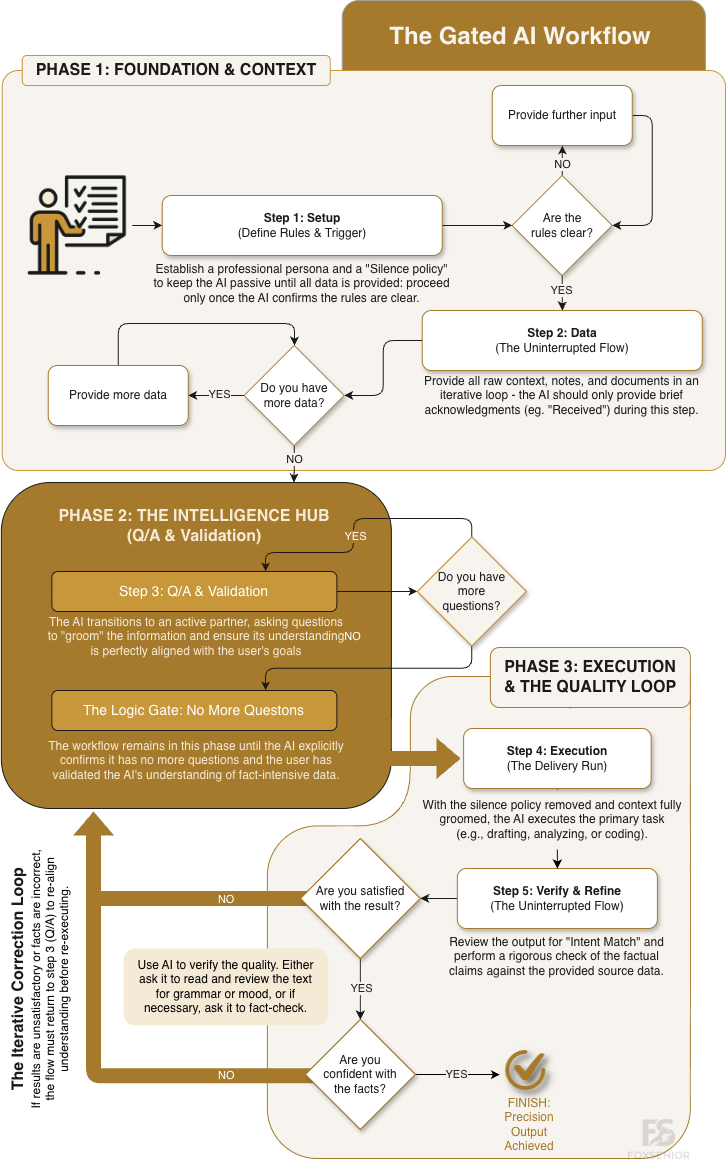
Workflow Overview and Core Objectives
The Gated AI Workflow is a high-precision framework I developed to maximize the reliability and accuracy of outputs from text-based AI tools. In an enterprise environment where “hallucinations” and “prompt drift” can compromise operational integrity, this workflow introduces a structured, iterative 5-step architecture.
The primary objective is to transition from “hope-based” prompting to a governed, iterative process that validates understanding before execution. The workflow is organized into five distinct logic gates:
- Setup — establishing system constraints and triggers
- Data — providing the model with all the data it needs
- Q/A — Questions & Answers — validating semantic understanding via iterative inquiry
- Execution — deploying the task
- Verify — final-mile fact-checking and source integrity
Phase 1: Setup — Defining the Foundation
In the Setup phase, you define the system constraints, governance parameters, and the specific trigger that initiates the workflow. This phase is the foundational anchor for the entire interaction.
Here is an example setup prompt I use myself:
I will now provide you with data and context. Do not take any action, ask questions, or draw conclusions until I explicitly prompt you with: “Do you have any questions?” Acknowledge each input only with “Received” — no comments, observations, or questions until prompted. The data may arrive in multiple parts and in no particular order.
Logic Gate: Are the rules clear?
- NO → Provide further input and re-enter Setup to refine the instructions.
- YES → Proceed to Data ingestion.
Important Note: Precision at the Setup phase is non-negotiable. Proceeding to data ingestion with suboptimal rules is the primary cause of downstream execution failure.
Phase 2: Data — The Uninterrupted Flow
The Data phase focuses on providing the AI tool with the specific context, data, and documentation required to execute the task. The AI should only provide brief acknowledgments (e.g., “Received”) during this step.
When providing data, you can add a short label describing the content — for example “Analysis of flowers” or “Q3 sales report”. This makes it easier to reference specific materials clearly during the Q/A phase.
Logic Gate: Do you have more data?
- YES → Provide more data. The workflow remains in this phase, building a complete picture for the AI.
- NO → Proceed to Q/A & Validation.
Phase 3: Q/A & Validation — The Intelligence Hub
This phase is triggered by the activation condition defined in Step 1: “Do you have any questions?”
The Q/A phase acts as a mandatory validation gate to ensure the AI tool has correctly interpreted the rules and context. The AI transitions to an active partner, asking questions to “groom” the information and ensure its understanding is perfectly aligned with your goals.
Logic Gate: Does the AI have more questions?
- YES → Remain in Q/A. Provide the necessary clarifications until the model confirms complete understanding. End each clarification with: “Do you have any more questions?”
- NO → The workflow advances to Execution. The workflow remains in this phase until the AI explicitly confirms it has no more questions and you have validated the AI’s understanding of fact-intensive data.
Note: At this stage you can also ask the AI to fact-check the data you provided — simply say: “Please fact-check.” This is especially useful if the data contains claims you are not entirely certain about. The AI is an excellent research companion here.
Phase 4: Execution — The Delivery Run
This phase is triggered by a concrete action request — for example “Please write a draft report” or “Write a summary of the analyses”.
With the silence policy removed and context fully groomed, the AI executes the primary task (e.g., drafting, analyzing, or coding).
This phase separates the AI’s mechanical work from the human’s cognitive audit:
- Execute — The AI processes the instructions and generates the output.
- Read the result — Mandatory human-in-the-loop action: evaluate the output against the original intent established in Phase 1.
Phase 5: Verify & Refine — The Uninterrupted Flow
This phase has two logic gates — both are important and you can choose the order yourself:
1. Review — read the output carefully. You can also ask the AI to do this — it is surprisingly attentive. But do it yourself as well.
2. Fact-check — since the output may differ from the source data you provided, ask the AI to verify factual accuracy against the sources. Check yourself as well.
Logic Gate: Are you satisfied with the result and are the facts correct?
- NO → The flow returns to Step 3 (Q/A). This prevents the accumulation of hallucination debt.
- YES → ✅ FINISH: Precision Output Achieved
Note: If the issue is minor — such as style, length, or a single factual error — a simple correction instruction is enough: “make it shorter”, “change the tone”, or “factual error in paragraph 3”. This goes directly back to Step 4. If the problem is deeper and requires rethinking the context, return to Step 3.
Final Checklist
- Setup Confirmed — Are the system constraints and triggers explicitly defined?
- Data Ingestion Complete — Has all required context been provided to the model?
- Semantic Alignment — Has the AI confirmed it has zero remaining questions?
- Intent Verified — Does the execution output meet 100% of the original intent?
- Fact Integrity — (If applicable) Are all facts and sources verified as accurate?